Resonance was conceived of six episodes of a show as an attempt to imagine a world that does not come after AI, but alongside it. Artificial intelligence has already entered daily life and creative practice. The question is no longer whether it should exist, but how human meaning continues to exist in its presence. It is an experiment exploring how we might return to the rituals of nature without falling into a reactionary amnesia about technology.
Generative systems classify, predict and synthesize patterns from accumulated culture. They operate through recognition and stabilization. Human experience, however, does not only consist of recognition. It also consists of transformation. The exhibition explores this difference.
The drawings were made over sixty AI-generated images. I covered the machine images with color crayons, not to correct them but to learn from them physically. By tracing, interrupting and reinterpreting the generated scenes, I attempted a reversal of training. Instead of the human training the machine, the machine image trained the human hand, and the human gesture altered the image again. This “reverse-AI” process does not oppose the machine. It restores reciprocity. It reveals that perception is not only classification but embodied interpretation.
The mosaics, assembled in five groups of twelve images, form a field of negotiated perception. AI produces coherent surfaces, but drawing reintroduces hesitation, emphasis, and subjective attention. The hand does not optimize. It resonates.
This is important because technological naturalism increasingly presents the world as predictable. Systems learn from past data to stabilize future behavior. Yet biological and ecological reality is not primarily stable. It is adaptive, fluctuating, and relational. Human cultures historically created rituals precisely to navigate transformation: solstices, eclipses, initiations, mourning, naming. Rituals were technologies allowing societies to acknowledge change without losing meaning.
The exhibition proposes that art and ritual still perform this function. Rather than rejecting AI, the work creates a space where classification pauses and experience becomes present again.
The poems were typed on a rebuilt IBM Selectric II typewriter. The machine is precise but not computationally generative. It produces marks without prediction. Its slowness allows thought to remain perceptible. The text therefore exists not as information but as an event of writing. It demonstrates that meaning can be produced through attention rather than automation.
Each day included a performance with Ásdís Sif (voice), Nico Guerreiro (guitar), and Tristan Zand (bass). The performances followed the dates and their symbolic thresholds: new moon, eclipse, carnival, and closing numerology. Ásdís draws from Icelandic myth and pagan narrative, Nico explores trance, repetition and sonic ritual, and I work with materials such as stones, moss and plants. These are not decorative references to nature but attempts to align artistic practice with processes of transformation rather than representation.
Guest participants extended this field. Reza Kalfane presented the album Noaidi Phrenia. Þrain and Kjartan performed acoustic songs. Klaudyna introduced a living sculpture of fermentation. Natalia offered rapid tarot readings. AleThesis performed with projected video. Each intervention functioned less as entertainment than as a temporary social rite, creating moments where identities, roles and interpretations could shift.
In this sense the exhibition itself became part of the artwork. It was not only a display of objects but a constructed environment in which humans gathered, listened, interpreted and changed together. Ritual here is understood as a form of technology, not a rejection of modernity but a complement to it. Computational systems organize knowledge; rituals organize meaning.
The project therefore does not claim that humans must defeat AI. Instead it asks a more urgent question: how can human livelihoods, artistic learning, and shared cultural experience continue when generative systems can reproduce the appearance of culture? The answer proposed is not prohibition but participation. By reintroducing embodied practice, communal presence and symbolic transformation, humans retain agency.
Resonance names this condition. It is the moment when different systems, biological, social and technological, coexist without one fully determining the other. Artificial intelligence classifies the world. Ritual allows humans to live within it.
Exploring a step beyond AI: a return of human presence within the flood of generated slop.
Resonance approaches the machine not as a replacement for perception but as a surface against which awareness can reappear. Through reverse-AI gestures, sound, spoken word and improvisation, generated material is brought back into contact with the body and shared attention. Revival of the meaning through the gathering of our souls.
This exhibit will include large format pencil drawn / printed mosaics of reversed training from the AI reality back to our physical analog world. The generated source material from the 30 year anniversary analog art from this website will be looping and performances related to the reappropriation of reality by means of analog rituals will happen every day: with friends (cf program below).
As machine learning increasingly mediates how images, language and memory circulate, the question is no longer whether machines create, but how humans continue to mean. The project proposes small rituals of listening and repetition, borrowing from myth and collective performance, not as nostalgia but as a complementary mode of understanding beside analytic and Cartesian thought.
Resonance here is both literal and human. Vibrations pass between voices, spaces, algorithms and listeners. When generated outputs are replayed, spoken, or improvised together, they cease to be isolated data and become experience. Meaning emerges not from the machine alone, nor from the individual alone, but from the interaction between presences.
Rather than rejecting technology, the performances use it as friction. By passing synthetic material through memory, voice and shared time, creation becomes less production and more attunement: an affirmation of being alive within an era of artificial abundance.
The exhibit features large reverse-AI drawings and poems as well as projection of videos from various works (schedule to come). The event will also be an opportunity to discover the book corner.The exhibit opens on Tuesday 17.02.2026 to the intertwined events that are the Full Solar Fire Eclipse, the first day of the Lunar New Year, and Mardi Gras. The daily performances will reflect that in a performative way and end on the 22.2 (Sunday).
Come see the art, the art books and music albums and have fun with us and share a drink.
Every day from 14-20h unless special event! Yay! Program evolving until last minute.
Day 1 - Tuesday 17.2: I Shall Rebirth - New Moon shedding the Snake with the Year of the Horse Fire Sun Eclipse Mardi Gras
14h opening and main exhibition / projection
15h listening party for album 7 of Brebis "Noaidi Phrenia" (1h)
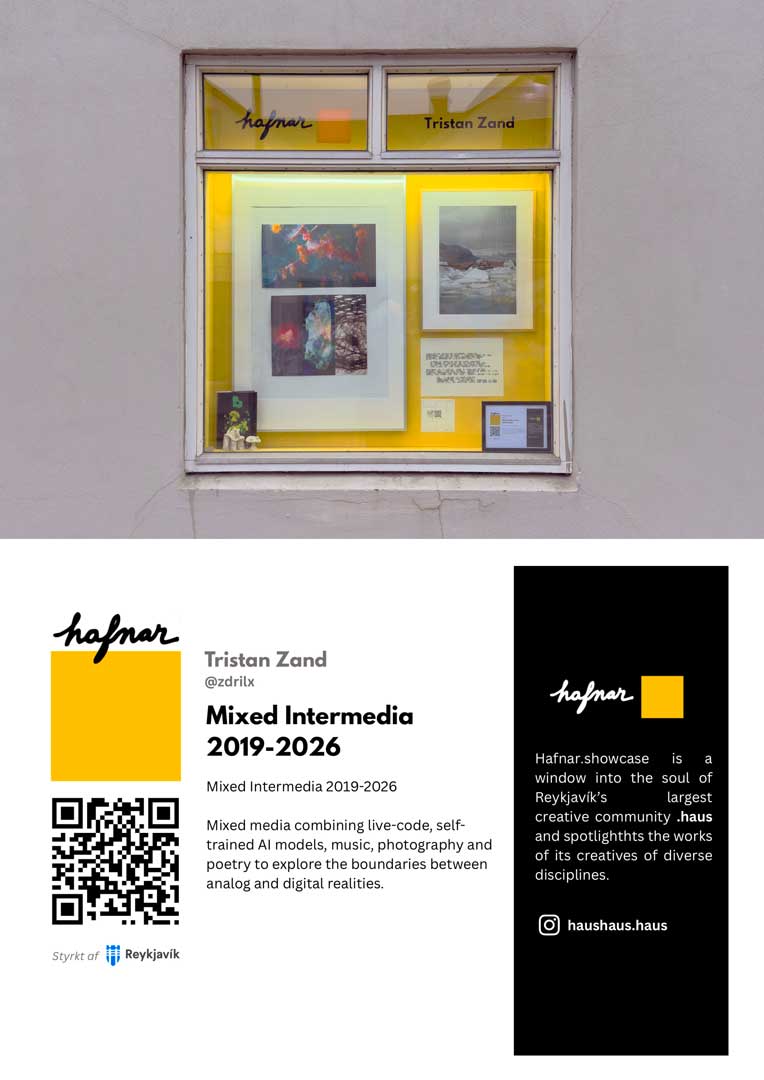
Go also check the Hafnarhaus Showcase at Tryggvagata 17, 101 Reykjavík !
There is a selection of prints from live-code mixed intermedia, AI, and traditional photography, sculptures and poems.